Choosing pet food can be confusing when you’re faced with long ingredient lists, nutritional information, feeding instructions, and unfamiliar terms.
Understanding how to read a pet food label can help you make more informed choices and select food that is appropriate for your pet’s needs.
While the ingredient list is useful, it is only one part of the label. You should also consider the food’s nutritional adequacy, life-stage information, feeding instructions, and calorie content.
1. Check Who the Food Is Made For
When learning how to read a pet food label, start by checking whether the food is designed for your pet.
Dog food and cat food are not interchangeable. Cats have nutritional requirements that differ from those of dogs, so food should be appropriate for the species it is intended for.
The label should also indicate whether the food is intended for a particular life stage, such as:
- Puppy or kitten
- Adult
- Senior
- All life stages
Choose food that is appropriate for your pet’s current stage of life unless your veterinarian recommends otherwise.
2. Look for Nutritional Adequacy Information
One of the most important things to check when learning how to read a pet food label is whether the food is intended to provide complete and balanced nutrition.
A food described as complete and balanced is formulated to provide the nutrients a pet needs when fed as directed. AAFCO identifies the nutritional adequacy statement as an important part of evaluating whether a food is appropriate for a particular species and life stage.
This is different from products intended only as treats, snacks, toppers, or supplements.
If the product is not intended to be a complete diet, it should not automatically replace your pet’s regular food.
3. Read the Ingredient List
Ingredients are generally listed in descending order by weight.
The ingredient list can help you understand what is included in the food, but it should not be used as the only way to judge nutritional quality.
A long ingredient list does not necessarily mean a food is better, and a short list does not automatically mean it is worse.
Different ingredients provide different nutrients, and the overall formulation matters. WSAVA specifically notes that ingredient lists alone do not provide enough information to determine the overall nutritional quality of a pet food.
4. Check the Guaranteed Analysis
The guaranteed analysis provides information about certain nutrients in the food.
Depending on the product, you may see values for:
- Crude protein
- Crude fat
- Crude fiber
- Moisture
In the United States, these four basic guarantees are commonly required on pet food labels, with protein and fat listed as minimum percentages and fiber and moisture as maximum percentages.
These numbers can help you compare foods, but they need to be interpreted in context.
For example, comparing the protein percentage of a dry food directly with the protein percentage of a wet food can be misleading because wet food contains much more water.
5. Pay Attention to Calories
Calories are an important part of managing your pet’s weight.
Two foods can have different calorie concentrations even when their basic nutrient percentages look similar.
If your pet tends to gain weight easily, knowing how many calories are in the food can make portion control easier.
Use the calorie information along with your pet’s body condition and your veterinarian’s recommendations when determining how much to feed. WSAVA also recommends considering calorie content when selecting and feeding pet food.
6. Look at the Feeding Instructions
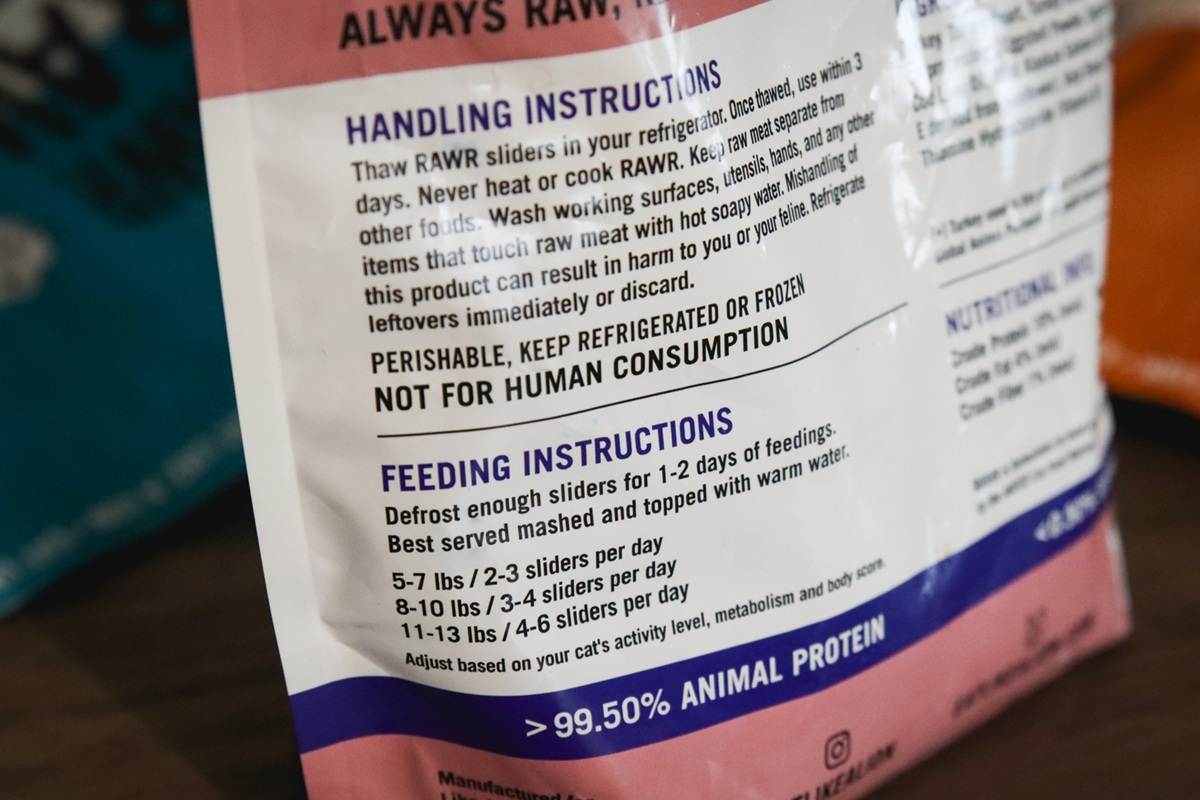
Pet food labels typically provide recommended feeding amounts based on factors such as body weight.
These recommendations are useful as a starting point, but they aren’t necessarily perfect for every individual pet. AAFCO notes that feeding directions may need to be modified to meet an individual pet’s needs.
Your pet’s activity level, age, metabolism, health, and body condition can all affect how much food they actually need.
Monitor your pet’s weight and body condition and adjust portions when appropriate.
7. Understand the Difference Between a Meal and a Treat
Not every pet food product is designed to be a complete meal.
Some products are intended as:
- Treats
- Snacks
- Food toppers
- Supplements
- Occasional foods
If a product is designed to be fed only occasionally, it should generally make up a smaller part of your pet’s overall diet.
Giving large amounts of treats or supplemental foods can add significant calories over time.
8. Don’t Judge Food Only by the Ingredient List
It’s easy to focus entirely on the first few ingredients, but pet nutrition is more complicated than simply identifying one ingredient.
A balanced pet food needs to provide appropriate amounts of many different nutrients.
The quality of the overall formulation, nutritional adequacy, calorie content, and suitability for your pet are all important considerations.
When deciding how to read a pet food label, remember that the ingredient list is only one piece of the bigger picture. WSAVA recommends looking beyond ingredients and considering nutritional adequacy, calorie information, manufacturer information, and other label details.
9. Consider Your Pet’s Individual Needs
The best food for one pet may not be the best choice for another.
Consider factors such as:
- Age
- Species
- Size
- Activity level
- Body condition
- Food preferences
- Existing health conditions
- Dietary requirements
Pets with certain health conditions may need specially formulated diets. In those cases, your veterinarian can recommend an appropriate option.
10. Check the Storage Instructions
Reading the label doesn’t stop once you’ve chosen the food.
Pay attention to storage instructions and expiration or best-before information. Store food in an appropriate location and keep packaging closed when possible.
For wet food, follow the package instructions for refrigeration and how long the food should be used after opening.
Proper storage helps maintain food quality and reduces the risk of spoilage.
Common Pet Food Label Mistakes
There are several easy mistakes to make when comparing pet foods.
Focusing Only on the First Ingredient
The first ingredient doesn’t tell you everything about the nutritional value of the food.
Assuming More Protein Is Always Better
Different pets have different nutritional requirements. More of a particular nutrient isn’t automatically better for every animal.
Ignoring Calories
Even a nutritionally appropriate food can contribute to weight gain if your pet consistently eats more calories than they need.
Comparing Wet and Dry Food Directly
Because moisture levels differ significantly, percentages on wet and dry foods aren’t always directly comparable.
Ignoring Life Stage
A food formulated for one life stage may not be appropriate for another. Always check the intended life stage on the packaging.
When to Ask Your Veterinarian
If you’re unsure which food is appropriate for your pet, your veterinarian can help you evaluate your options.
Professional guidance is particularly useful if your pet:
- Is overweight or underweight
- Has a medical condition
- Has food allergies or sensitivities
- Is pregnant or nursing
- Is very young or elderly
- Has recently experienced unexplained weight changes
- Needs a special therapeutic diet
The Bottom Line
How to read a pet food label becomes much easier when you know which information matters most.
Check the species and life stage, nutritional adequacy information, ingredients, guaranteed analysis, calorie content, and feeding instructions. Then consider your pet’s individual needs rather than choosing food based on one ingredient or marketing claim.
A pet food label can provide valuable information, but no single part of the label tells you everything you need to know. If you’re uncertain about which food or feeding plan is appropriate for your pet, your veterinarian can help you make an informed decision.